
What you need
- Sandalwood stick (20–30 g is enough for a household) — heartwood, marked.
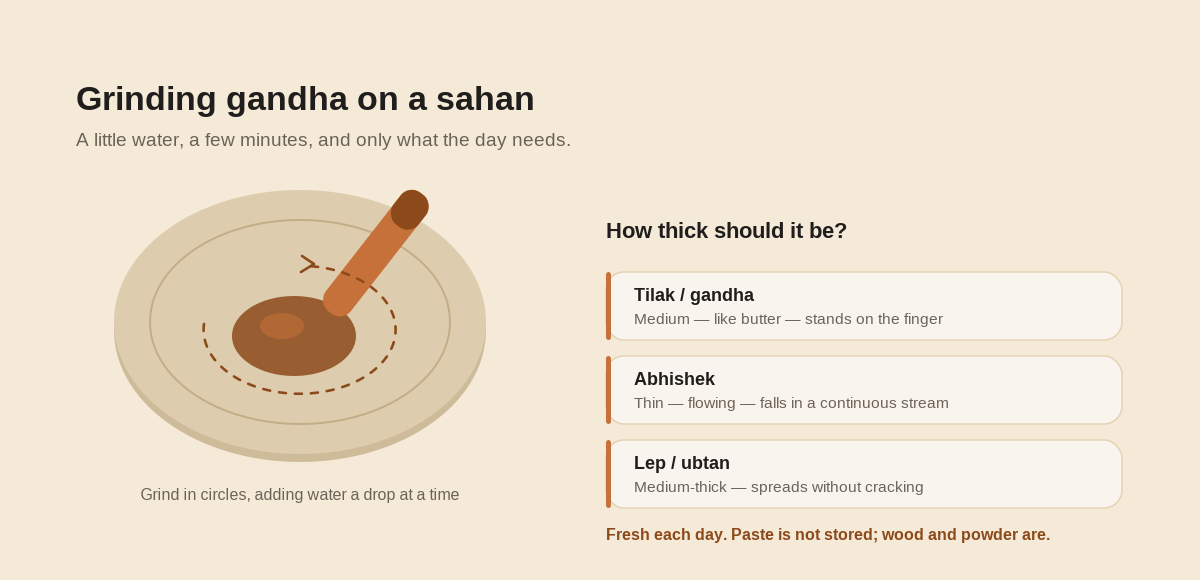
- Sahan — the flat, slightly rough stone used for grinding sandalwood. If you do not have one, a clean, rough stone surface will do.
- Clean water, to be added drop by drop.
- A small bowl to hold the paste, and a clean spoon or finger from the puja shelf.
Step by step: grinding on the sahan
- Wash the sahan clean and wipe it, removing any old dried paste.
- Put half a spoon of water in the middle of the sahan — less rather than more to begin with.
- Rest the tip of the stick in the water and grind in circles with moderate pressure.
- As the paste gathers, add water a drop at a time to hold the consistency.
- In 3–5 minutes there is enough paste for tilak; for abhishek, grind longer or use the powder method.
- Lift the paste into the bowl, wipe the tip of the stick and let it dry in the air (see the storage guide).
How to judge the right consistency
| Use | Consistency | Sign |
|---|---|---|
| Tilak / gandha | Medium — like butter | Stands on the finger without running |
| Abhishek | Thin — flowing | Falls from the spoon in a continuous stream |
| Lep / ubtan | Medium-thick | Spreads on the skin without cracking |
If the paste feels gritty, grind it longer — genuine heartwood paste feels smooth and faintly oily between the fingers. That is also the everyday sign of purity.
The powder method: the same paste, in moments
Take half a spoon of pure sandalwood powder in a bowl, add water a drop at a time and work it together with a finger or spoon. Break up the lumps and bring it to the consistency you want. Powder with 4% oil gives the same heartwood paste — the only difference is convenience. If grinding every day is not practical, this is the honest alternative.
Mistakes to avoid
- Too much water at once — the paste thins and the grinding is wasted; always add water a drop at a time.
- Leaving the stick wet — the tip spoils with mould; wipe it and let it dry after use.
- Storing the paste — the tradition is of fresh paste; do not use yesterday's paste today.
- An unclean sahan — particles of old paste spoil the quality of the new.
Frequently asked questions
Frequently asked questions
- What if I do not have a sahan?
- A clean, rough stone surface will do; or use the powder method — the paste is the same.
- How long does the paste keep?
- Fresh paste is for that day's puja. Storage should be as wood or powder, not as paste.
- Should milk be used while grinding?
- Some traditions use milk or rose water for particular rituals. For everyday paste, clean water is the norm; follow your own tradition.
- How long does one stick last?
- In ordinary household use, a 20–30 g stick usually lasts several months.