
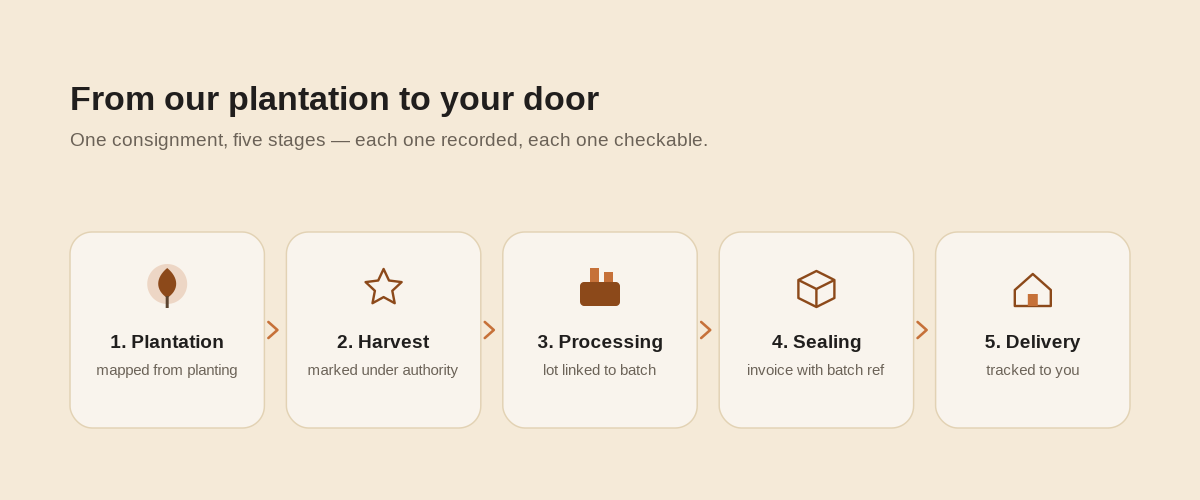
Stage 1: The plantation
Our trees grow at the plantation in Parner taluka, each sandalwood sapling planted alongside its host plant — sandalwood cannot grow alone — and mapped from planting day. The plantation is registered, and its records are what make everything downstream lawful.
Stage 2: Harvest, under supervision
A tree is harvested only at maturity and only through the lawful process. The harvested wood is verified, and the property mark is applied under Forest Department authority — the stamp you can later find on your billet or stick. A transit pass then authorises the wood's movement to our facility. This is the least photogenic and most important stage of the whole chain.
Stage 3: Processing at the facility
At the facility, heartwood is separated and graded; billets are cut to retail sizes, sticks shaped, powder ground, and oil steam-distilled — each batch logged against its source lot. This lot-to-batch link is what lets us answer, for any bottle or billet you hold, exactly which wood it came from.
Stage 4: Sealing and packing
Products are sealed — the seal is your purity guarantee — and packed with the invoice that carries the batch reference. The parcel that leaves here is tamper-evident; if a seal ever arrives broken, that is the one case where we ask you not to use the product and to contact us with photos.
Stage 5: To your door
Dispatch with tracking, delivery, and then the journey's last step belongs to you: check the seal, keep the invoice, and — if you want to — verify the batch against the mark using our verification guide. The chain that began at a mapped tree in Parner ends with a document in your hand.
Why we show all this
Because in this category, trust is not a tone of voice — it is a chain of custody. Any seller can write the word 'pure'. Showing the plantation, the marks, the documents and the people is the only honest way to prove it, and it is the standard we are happy to be held to.