
But sandalwood is not an ordinary wood product.
Because sandalwood is a regulated forest produce and its movement, processing and trade are subject to applicable laws and permissions, buyers often have questions such as:
- Is it legal to buy sandalwood in India?
- Can I keep sandalwood at home?
- Can sandalwood grown on private land be sold?
- What documents should I ask for?
- How can I know whether sandalwood is legally sourced?
- Does sandalwood need a transit pass?
- What is a sandalwood permit number?
- Can sandalwood products be transported with an invoice?
- Can sandalwood be exported from India?
The short answer is that legally sourced and properly documented sandalwood can be bought, sold, processed and used, but the applicable requirements depend on the source, state, form of sandalwood and nature of the transaction.
The safest approach is simple:
Know the source. Verify the documentation. Check the applicable Forest Department requirements. Maintain the purchase records.
Is It Legal to Buy Sandalwood in India?
Yes, sandalwood can be legally bought and sold when it has been sourced and handled in accordance with the applicable laws, permissions and documentation.
The important distinction is between legally sourced sandalwood and sandalwood whose origin or movement cannot be properly established.
A legitimate transaction should have a traceable source and appropriate documentation.
In Maharashtra, sandalwood is specifically covered by the state's forest-transit framework. The Maharashtra Forest Rules, 2014 apply throughout the state, and the rules provide for property and transit marking of sandalwood and other specified forest produce.
This means that a buyer should not look only at the physical appearance or fragrance of the wood.
The documentation and traceability of the sandalwood are equally important.
Can I Keep Sandalwood at Home?
Legally purchased sandalwood should be accompanied by appropriate purchase documentation, such as a valid tax invoice and other applicable records.
For an ordinary consumer purchasing sandalwood products from a legitimate seller, the most important practical step is to retain the purchase invoice.
The invoice establishes where the product was purchased and provides a record of the transaction.
For regulated sandalwood products, however, buyers should not assume that an invoice alone answers every regulatory question. The requirements can depend on the form and quantity of sandalwood, its source and the applicable state rules.
Therefore, when purchasing sandalwood, particularly in larger quantities or in raw forms such as logs and heartwood, buyers should ask the seller:
"What is the legal source of this sandalwood, and what documentation identifies it?"
Why Is Sandalwood Different from Ordinary Wood?
Sandalwood is a forest produce with a long history of regulatory control.
The Maharashtra Forest Rules specifically address sandalwood in relation to property marks, transit marks and movement of forest produce. Under the rules, scented sandalwood is specifically included among the materials requiring distinguishable marking arrangements for movement in the circumstances covered by the rules.
The Maharashtra Forest Department also operates systems and services relating to transit-pass registration and industrial transit passes.
This regulatory framework exists to help establish the legitimate source and movement of forest produce.
For a buyer, this leads to an important principle:
Do not judge sandalwood only by how it looks, smells or feels. Ask where it came from and how its legal origin can be established.
Can Sandalwood Be Grown on Private Land?
Sandalwood can be cultivated on private agricultural land, subject to the applicable state requirements.
For Maharashtra, the land and plantation records are important in establishing the connection between the grower and the trees.
A grower should maintain appropriate land records, including the relevant 7/12 extract, showing the landholding and the plantation where applicable.
However, growing a sandalwood tree and subsequently cutting, transporting, processing and selling the resulting sandalwood are different stages.
The fact that someone has grown a sandalwood tree does not by itself mean that the resulting wood can be freely cut, transported or sold without following the applicable procedures.
Does Growing a Sandalwood Tree Mean I Can Cut It Whenever I Want?
No.
This is one of the most important distinctions for sandalwood growers.
There are several separate stages:
Growing → Harvesting → Processing → Transport → Sale
The legal requirements applicable to one stage should not automatically be assumed to apply to all the others.
For example, a grower may establish ownership of the land and plantation through land records, but when the tree is ready for harvesting, the applicable permission and documentation process must be followed before the wood is cut, processed, transported or sold.
The Maharashtra Forest Department currently lists services relating to permission for felling trees in non-urban areas as well as transit-related services.
Therefore:
Planting sandalwood does not mean that the wood can automatically be harvested and sold without following the applicable procedure.
What Documents Should a Buyer Ask For?
If you are buying sandalwood, particularly raw sandalwood such as logs, billets or heartwood, ask the seller how the material can be traced back to its legal source.
Depending on the transaction, useful documentation may include:
- Tax invoice
- Permit or Forest Department documentation
- Transit documentation, where applicable
- Permit/lot identification
- Registered property or hammer mark
- Source/ownership documentation where relevant
- Laboratory or quality report, where applicable
The exact documents required can vary according to the source, product and transaction.
A responsible seller should be able to explain the provenance of the material rather than simply saying:
"This is genuine sandalwood."
Genuine sandalwood and legally sourced sandalwood are related but different questions.
A product may physically be sandalwood, but a buyer should also be able to establish that it was legally sourced and moved.
What Is a Sandalwood Permit Number?
A permit or Forest Department identification number can play an important role in traceability.
Where applicable, the permit number can help identify the source and regulatory documentation associated with a particular quantity or lot of sandalwood.
For this reason, buyers should be cautious when a seller claims that sandalwood is "legal" but cannot explain its applicable permit or source documentation.
A useful question to ask is:
"What is the permit or Forest Department identification associated with this sandalwood?"
Where the applicable system provides a permit number, buyers can use that information as part of their due diligence.
What Is a Hammer Mark or Property Mark?
A property mark is a registered identifying mark used for forest produce in circumstances covered by the applicable rules.
The Maharashtra Forest Rules provide for distinguishable private property marks and, where directed, government transit marks for specified forest produce. The rules specifically include scented sandalwood in these marking provisions.
In practical terms, a registered mark helps connect the material with its authorised owner or source.
This is why buyers dealing with raw sandalwood should pay attention not only to the wood itself but also to the applicable markings and documentation.
What Should I Check Before Buying Sandalwood?
Here is a simple buyer checklist.
Before purchasing, ask:
Who is the seller?
Verify the business identity and whether the seller is authorised to deal in the relevant sandalwood product.
Where did the sandalwood come from?
A legitimate seller should be able to explain the source.
What is the applicable permit/documentation?
Ask for the relevant permit or identification number where applicable.
Is there a property/hammer mark?
For raw sandalwood, check the applicable marking requirements.
Will I receive a tax invoice?
Always retain the invoice.
Is transport documentation required?
Ask whether the consignment requires a transit pass or other transport documentation.
Is there a laboratory report?
For products such as sandalwood oil and powder, laboratory testing can provide additional information about identity and quality.
What Does a Legally Traceable Sandalwood Supply Chain Look Like?
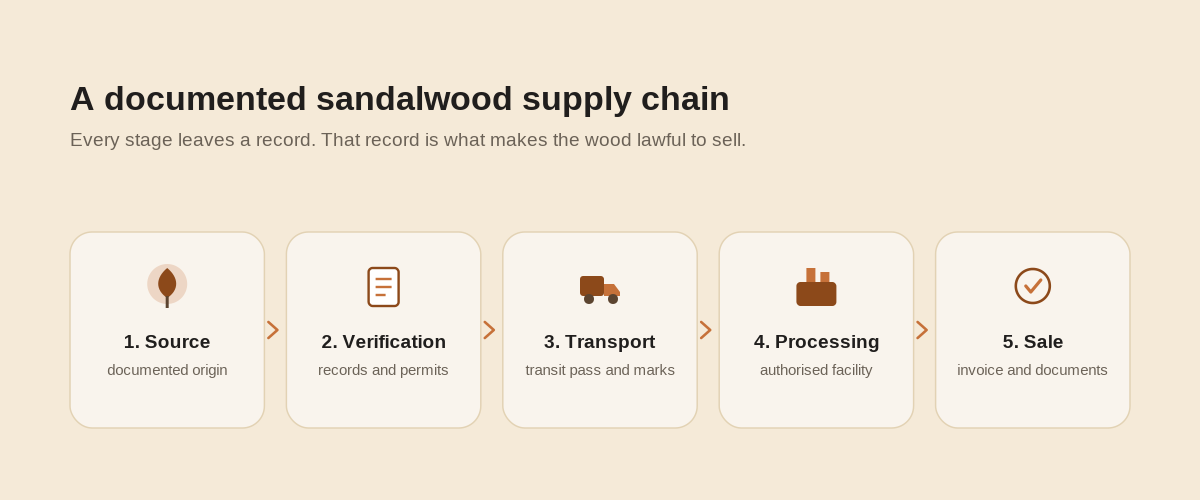
A properly documented sandalwood supply chain can be understood through five broad stages:
Source
The sandalwood originates from a documented and legitimate source.
↓
Verification
Ownership, land records, permits and other applicable documentation are verified.
↓
Transport
The sandalwood is moved using the applicable transit documentation and markings.
↓
Processing
The sandalwood is processed into products such as sticks, powder or oil at an appropriately authorised facility.
↓
Sale
The finished product is sold with the applicable commercial and tax documentation.
This is the basic principle behind traceability:
The customer should be able to understand where the sandalwood came from and how it reached them.
How Does Sandalwood Move to a Processing Facility?
When legally purchased sandalwood is procured from a farmer, the source documentation is established and the applicable Forest Department procedure is followed.
For example, at Shri Siddheshwar Sandalwood, sandalwood procured from farmers is supported by ownership documentation such as relevant 7/12 records, along with the applicable Forest Department permits and transport documentation.
The material is moved to the company's depot under the applicable permit and transit system.
Our company maintains its own numbered transit-pass book as part of its authorised operations.
The Maharashtra Forest Department's current systems also provide for transit-pass registration and related services.
How Shri Siddheshwar Sandalwood Maintains Traceability
At Shri Siddheshwar Sandalwood Oil & Products Pvt. Ltd., traceability is an important part of our operating process.
Our company holds permissions relating to:
- Purchase of sandalwood
- Depot/storage
- Processing
- Sale
- Applicable transportation and transit procedures
We also maintain the relevant GST and commercial documentation.
Our objective is to ensure that sandalwood entering our system can be connected to its documented source and that products leaving our facility can be commercially and operationally traced.
Our Registered Sandalwood Marks
Our operations use registered identifying marks for different stages of the sandalwood supply chain.
★ AH-S-4
AH-S-4 is our registered mark used for sandalwood bought and sold through our depot.
Where applicable, the mark is stamped on the sandalwood and associated transit documentation.
★ AH-S-2
AH-S-2 is our registered mark for finished products manufactured at our processing unit.
This includes products such as:
- Sandalwood powder
- Sandalwood oil
- Sandalwood perfume
- Sandalwood incense
These marks form part of our identification and traceability system.
Can a Buyer Verify the Sandalwood?
A responsible buyer should ask for the information needed to establish the product's legitimate source and identity.
For raw sandalwood, this can include:
- Applicable permit number
- Source documentation
- Property/hammer mark
- Transit documentation
- Seller's invoice
- Quantity and description of material
For processed products, the relevant identification may be connected to the raw material and processing documentation.
At Shri Siddheshwar Sandalwood, we believe that authenticity should not depend solely on a seller's claim.
It should be supported by documentation and traceability.
What About Sandalwood Sticks, Powder and Oil?
Sandalwood is sold in several forms, and the regulatory and documentation considerations can differ depending on the product.
Sandalwood Logs / Heartwood
Raw sandalwood is subject to the relevant source, marking, processing and transit requirements.
Sandalwood Sticks
Finished or processed sticks should be purchased from a legitimate seller with an appropriate invoice and traceability information.
Sandalwood Powder
The buyer should verify the identity of the product, seller and applicable source/traceability information.
Sandalwood Oil
The buyer should pay particular attention to:
- Manufacturer
- Batch/lot information
- Invoice
- Product identity
- Quality/laboratory documentation
- Traceability of the sandalwood used for production
A laboratory report can help establish quality characteristics, but a laboratory report is not by itself a substitute for legal-source documentation.
Does a Tax Invoice Matter?
Yes.
A tax invoice is an important commercial record of the transaction.
When purchasing sandalwood products, customers should retain their invoice because it provides evidence of:
- Who sold the product
- What product was purchased
- Quantity
- Price
- Date of transaction
- Applicable GST details
For consumers purchasing finished products, keeping the invoice is a simple and useful precaution.
For businesses purchasing sandalwood in larger quantities, the documentation trail becomes even more important.
How Is Finished Sandalwood Product Transported?
The transport requirements depend on the nature of the material and the applicable rules.
At Shri Siddheshwar Sandalwood, finished sandalwood products are dispatched with the applicable commercial documentation, including a tax invoice and e-way bill where applicable, along with any other documentation required for the particular movement.
For processed products, the applicable transit requirements can differ from those applicable to raw sandalwood.
Therefore, customers should not assume that the transport procedure for raw sandalwood logs is identical to that for a finished product such as sandalwood oil or powder.
What About Sandalwood Bought From Another State?
This is where buyers should be particularly careful.
Forest-product regulations are not necessarily identical across India.
A document or procedure that applies in one state should not automatically be assumed to satisfy the requirements of another state.
When sandalwood crosses a state boundary, the buyer and seller should verify the applicable requirements for:
- The state of origin
- The state of destination
- The type of sandalwood
- The form of the product
- The quantity
- The intended use
- The applicable transport documentation
Inter-state movement should always be checked against the current rules applicable to the specific consignment.
Can Sandalwood Be Exported From India?
Export is possible for certain sandalwood products, but it is not correct to treat all forms of sandalwood as freely exportable.
India's export policy distinguishes between different sandalwood products and forms.
DGFT's policy materials state that export of sandalwood in general is prohibited, while specified finished handicraft and machine-finished sandalwood products may be exported freely. Certain forms such as sandalwood oil and specified sandalwood waste/scrap products are subject to restricted export conditions and authorisation requirements.
Therefore, anyone planning an export transaction should verify the current DGFT policy, applicable HS/ITC classification and required authorisations for the specific product before accepting an export order.
At Shri Siddheshwar Sandalwood, we can undertake export transactions subject to the applicable regulatory requirements.
What Is the Biggest Mistake a Sandalwood Buyer Can Make?
The biggest mistake is buying sandalwood based only on trust.
A seller may say:
"It is 100% genuine."
But a buyer should ask a second question:
"Can you show me how it is legally sourced and documented?"
Authenticity and legality are two different aspects of a sandalwood purchase.
A good purchasing process considers both.
A Simple Checklist for Consumers
Before buying sandalwood, remember:
✓ Buy from an identifiable seller
Know the name and business details of the seller.
✓ Ask about the source
The seller should be able to explain where the sandalwood came from.
✓ Ask for the applicable permit/identification
Where applicable, ask for the relevant permit number or source identification.
✓ Check the applicable mark
For raw sandalwood, check the relevant property/hammer mark and documentation.
✓ Take a tax invoice
Do not purchase regulated sandalwood without proper commercial documentation.
✓ Keep your records
Store the invoice and other documents received with the purchase.
✓ For larger or commercial purchases, conduct additional due diligence
Ask for the relevant permits, transport documentation and quality documents.
How We Look at Authenticity at Shri Siddheshwar Sandalwood
Our approach is based on three principles:
Source
We work with documented sources and maintain the relevant procurement records.
Traceability
We use applicable permit, marking and documentation systems to connect material with its source and processing journey.
Transparency
We provide customers with commercial documentation and, where applicable, quality and laboratory documentation for our products.
This creates a simple chain:
Source → Documentation → Transport → Processing → Testing → Finished Product → Customer
That is what we mean by farm-to-customer traceability.
What Should You Look for When Buying Sandalwood From Us?
When purchasing from Shri Siddheshwar Sandalwood, customers can ask our team about the documentation and traceability associated with their product.
Depending on the product, this may include:
- Product details
- Permit/identification information where applicable
- Applicable marking information
- Batch/lot details
- Tax invoice
- Transport documentation where applicable
- Laboratory/quality documentation where applicable
We believe customers should have confidence not only in the fragrance and quality of sandalwood, but also in its documented journey.
Final Takeaway
Sandalwood is a valuable and regulated forest product.
Buying sandalwood legally is not simply about finding genuine wood. It is about being able to establish its source, documentation, movement and legitimate sale.
For a buyer, the safest approach is straightforward:
Know your seller. Ask about the source. Check the applicable permit and marking. Take a proper invoice. Keep your records.
At Shri Siddheshwar Sandalwood, we follow a documented approach to procurement, processing and sale, with traceability built into our sandalwood supply chain.
From the source to the finished product, our objective is simple:
Authentic sandalwood. Documented sourcing. Responsible processing. Transparent supply.
Legal & Regulatory Note
This article is provided for general educational and informational purposes and should not be treated as legal advice. Forest, transit, trade and export requirements may change and may differ depending on the state, source, quantity, form of sandalwood, transaction and intended use.
Before undertaking the cultivation, harvesting, purchase, transport, processing, sale or export of sandalwood, the applicable current requirements should be verified with the relevant government authorities and, where appropriate, qualified legal counsel.
The information on this page should be reviewed periodically to reflect changes in applicable law and government procedures.
Official references
The Maharashtra Forest Department publishes the Maharashtra Forest Rules and provides current forest-related services including transit-pass registration.
India's Directorate General of Foreign Trade publishes the applicable export policy for sandalwood and sandalwood products.
Frequently asked questions
- Is sandalwood legal to buy in India?
- Yes, legally sourced sandalwood can be bought and sold subject to the applicable laws, permissions and documentation.
- Can I keep sandalwood at home?
- A person who purchases sandalwood legally should retain the purchase invoice and relevant documentation. Requirements can vary according to the product, quantity, source and applicable state rules.
- Can I grow sandalwood on private land?
- Sandalwood can be cultivated on private agricultural land subject to applicable requirements. Land and plantation records are important for establishing the source.
- Can I cut a sandalwood tree after growing it?
- Growing a sandalwood tree does not automatically mean that it can be harvested and sold without following the applicable procedure. The requirements for harvesting, processing, transport and sale should be verified before cutting the tree.
- What documents should I ask for when buying sandalwood?
- Depending on the transaction, ask for the tax invoice and the applicable permit, source, transit and marking documentation. Commercial buyers may require additional documentation.
- What is a sandalwood permit number?
- It is an identification associated with the applicable Forest Department documentation that can help establish the source and regulatory history of the sandalwood.
- What is a sandalwood hammer mark?
- A registered property or identifying mark can be used to identify sandalwood belonging to a particular authorised owner or source, as applicable under the regulatory framework.
- Is sandalwood oil legal to buy?
- Sandalwood oil can be legally purchased when manufactured and sold through a legitimate supply chain and in compliance with applicable requirements. Buyers should retain their invoice and check the manufacturer's credentials and product documentation.
- Can sandalwood be transported from one state to another?
- Inter-state movement may be subject to applicable transit and other regulatory requirements. These should be verified for the specific state, product and consignment.
- Can sandalwood be exported from India?
- Certain sandalwood products can be exported subject to the applicable DGFT policy and authorisations. The rules differ by product and form, so the current export policy should be checked before shipment.