
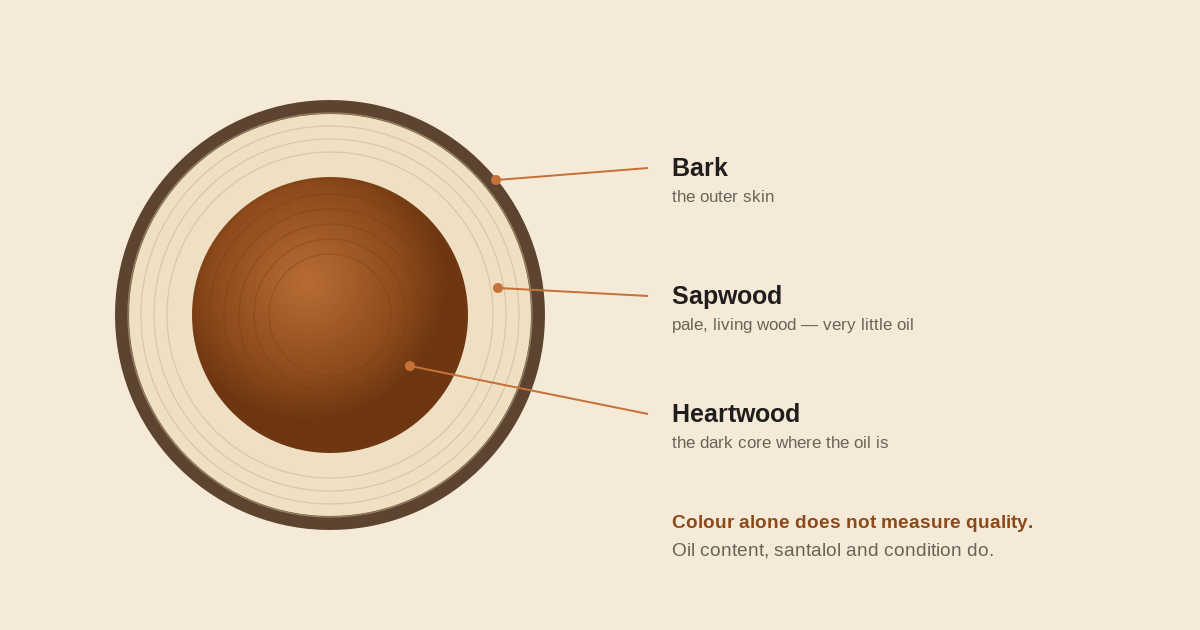
But a sandalwood tree is not made entirely of dark heartwood.
Inside a mature sandalwood trunk, there is a distinction between heartwood and sapwood. They look different, have different characteristics and can have very different commercial applications.
This distinction is important because one of the most common misconceptions about sandalwood is:
“The darker the sandalwood, the better the quality.”
That is not a reliable way to judge sandalwood quality.
Similarly, another common misconception is that sandalwood from a particular geographical region is automatically superior to sandalwood grown somewhere else.
In reality, the commercial value and suitability of sandalwood depend on several factors, particularly oil content, santalol content, size, density, physical condition and intended application.
At Shri Siddheshwar Sandalwood, we evaluate sandalwood based on its actual characteristics and customer requirements—not simply its colour or geographical origin.
What Is Heartwood?
Heartwood is the inner portion of the sandalwood trunk.
As the tree grows, the older inner wood undergoes changes that distinguish it from the younger outer wood.
In sandalwood, the heartwood is the part that contains the major concentration of the characteristic sandalwood oil and aromatic compounds.
This is why heartwood is generally the most commercially valuable part of the tree for applications where fragrance and sandalwood oil characteristics are important.
Visually, heartwood is usually darker than sapwood, although the exact colour can vary.
A cross-section of a sandalwood trunk can therefore show a lighter outer zone surrounding a darker inner core.
Important: Colour is an observable characteristic, but it should not be treated as a standalone measure of quality.
What Is Sapwood?
Sapwood is the lighter, younger outer portion of the trunk surrounding the heartwood.
It is genuine sandalwood—it is not automatically “fake sandalwood” simply because it is lighter in colour.
This is an important distinction.
Sapwood comes from the sandalwood tree and is botanically part of the tree’s wood. However, compared with heartwood, it generally contains much less sandalwood oil.
As a result, heartwood and sapwood have different commercial characteristics and are often used for different purposes.
At Shri Siddheshwar Sandalwood, we also supply sandalwood sapwood separately in bulk, depending on customer requirements and applications.
Heartwood vs Sapwood: What Is the Difference?
| Characteristic | Heartwood | Sapwood |
|---|---|---|
| Position in trunk | Inner portion | Outer portion |
| Typical colour | Generally darker | Generally lighter/ Creamy / White |
| Sandalwood oil | Main concentration | Significantly lower |
| Aroma | Generally stronger | Generally milder |
| Commercial applications | Oil, perfumery, premium products, carving and other applications | Applications where lower oil content is suitable |
| Commercial value | Generally higher where oil content is important | Depends on application and specification |
| Genuine sandalwood? | Yes | Yes |
The important point is:
Both heartwood and sapwood can be genuine sandalwood. Their characteristics and applications are different.
Why Does Heartwood Have More Oil?
Sandalwood is unusual because its commercially important aromatic oil is concentrated primarily in the heartwood.
As the tree develops, the inner wood undergoes physiological and chemical changes associated with heartwood formation.
The resulting heartwood contains the characteristic compounds responsible for sandalwood’s distinctive fragrance and much of its commercial value.
This is why the heartwood is particularly important for industries such as:
- Perfumery
- Fragrance
- Cosmetics
- Essential-oil production
- Premium incense
- Certain traditional and Ayurvedic applications
- Fine carving and premium sandalwood products
The exact oil content is not identical in every piece of sandalwood.
It can vary depending on the individual tree, maturity, portion of the wood and other factors.
Therefore, testing is more meaningful than simply looking at colour.
Is Darker Sandalwood Always Better?
No.
This is one of the biggest myths surrounding sandalwood.
A darker piece may visually appear more valuable, but colour alone does not establish the quality or oil content of sandalwood.
Two pieces can have similar colour but different oil characteristics.
Likewise, sandalwood from a particular location should not automatically be considered superior simply because of its geographical origin.
For commercial evaluation, factors such as:
- Oil content
- Santalol content
- Size
- Density
- Physical condition
- Heartwood proportion
- Intended application
can be much more meaningful.
At Shri Siddheshwar Sandalwood, we therefore do not classify a sandalwood log simply as “better” because it is darker or because it comes from a particular region.
The real question is not simply “How dark is it?” but “What does the wood actually contain, and what is it suitable for?”
Does the Region Where Sandalwood Grows Determine Its Quality?
Not by itself.
Sandalwood quality should not be reduced to a geographical label.
A common market belief is that sandalwood from one particular region is automatically superior to sandalwood grown elsewhere.
Such generalisations can be misleading.
Trees growing in different locations can show variation in their physical and chemical characteristics. But the actual quality of a particular piece or lot should be assessed on its characteristics rather than assumed purely from geography.
For applications where fragrance and oil are important, objective parameters such as oil content and santalol composition are particularly relevant.
This is why laboratory analysis can be useful when evaluating sandalwood for commercial applications.
What Is Santalol and Why Does It Matter?
Santalol refers primarily to the characteristic sandalwood alcohols found in sandalwood oil, particularly α-santalol and β-santalol.
These compounds are important contributors to the characteristic aroma and commercial properties of sandalwood oil.
For buyers in industries such as:
- Perfumery
- Fragrance
- Cosmetics
- Essential oils
- Certain pharmaceutical and Ayurvedic applications
the santalol profile can be an important quality consideration.
However, santalol content should be considered together with the overall product specification and intended application.
This is another reason why laboratory analysis can provide information that visual inspection alone cannot.
How Is a Sandalwood Log Evaluated?
There is no single visual characteristic that can tell you everything about a sandalwood log.
A commercial evaluation may consider several factors.
Oil content
For many applications, this is one of the most important characteristics.
Higher oil content can make the material more suitable for applications where sandalwood fragrance or oil extraction is important.
Santalol characteristics
The composition of sandalwood oil, including α-santalol and β-santalol, can be relevant for quality assessment.
Size of the log
Log diameter, length and overall dimensions affect the suitability of the wood for different applications.
Heartwood proportion
A log with a larger heartwood portion can provide more of the oil-rich material.
Physical condition
Factors such as cleanliness, damage, cracks and other physical characteristics can influence usability.
Intended application
A piece that is ideal for one application may not be the most economical choice for another.
Therefore:
Sandalwood quality is application-specific.
Why Does Log Size Matter?
Size does not automatically mean quality.
Instead, size determines suitability for a particular application.
For example, larger and structurally suitable pieces may be useful for carving, while smaller pieces can be processed into sticks, chips or powder.
Different customers require different specifications.
At Shri Siddheshwar Sandalwood, we can supply sandalwood in different forms, sizes and packaging configurations depending on customer requirements.
These can include:
- Logs
- Pieces
- Sticks
- Chips
- Powder
- Oil
- Other processed forms
The right specification therefore depends on what the customer intends to do with the sandalwood.
Heartwood vs Sapwood: Does One Always Have More Value?
Not necessarily in every commercial situation.
Heartwood generally commands greater value where high sandalwood-oil content is important.
But sapwood can also have a legitimate commercial application.
At Shri Siddheshwar Sandalwood, we supply both heartwood and sapwood, including sapwood in bulk, according to customer requirements.
The important question is:
What specification does the customer actually need?
If the application requires high oil content, heartwood may be the appropriate material.
If the application does not require high oil content, a different specification may be more appropriate and commercially efficient.
Which Sandalwood Should You Buy for Different Applications?
There is no universal “best” sandalwood.
The appropriate form depends on the intended use.
| Application | Commonly suitable form |
|---|---|
| Tilak / ritual use | Sandalwood sticks/ Logs |
| Premium carving | Suitable sandalwood logs |
| Perfumery | Sandalwood essential oil / oil-rich heartwood |
| Ayurvedic products | Sandalwood powder, according to formulation requirements |
| Incense | Appropriate sticks/powder/processed material |
| Industrial applications | Specification based on the customer’s process |
| Bulk manufacturing | Material selected according to required oil, size and processing specifications |
This is why professional buyers should communicate their end use, required quantity and specification before purchasing.
Can Sapwood Be Used?
Yes.
Sapwood is genuine sandalwood, although it generally contains considerably less sandalwood oil than heartwood.
Its suitability therefore depends on what the customer needs.
For certain applications where high oil content is not the primary requirement, sapwood can be a practical raw material.
At Shri Siddheshwar Sandalwood, sapwood is also supplied separately in bulk for customers whose applications require it.
The key is transparency.
Sapwood should be identified and sold as sapwood rather than represented as oil-rich heartwood.
How Can You Tell Heartwood and Sapwood Apart?
The most obvious difference is usually visual.
Heartwood
- Usually darker
- Located toward the centre of the trunk
- More strongly aromatic
- Contains the main concentration of sandalwood oil
Sapwood
- Usually lighter
- Located toward the outside of the trunk
- Less aroma
- Lower oil content
A cross-section of a sandalwood trunk provides one of the clearest visual demonstrations.
The outer lighter wood surrounds the darker heartwood core.
However, visual identification has limitations.
Colour alone cannot accurately quantify oil content.
For commercial or technical evaluation, laboratory analysis is more appropriate.
Why Laboratory Testing Matters
A visual inspection can tell you a lot about the physical material.
It cannot tell you everything about its chemical composition.
Laboratory testing can provide information about characteristics such as:
- Oil content
- α-santalol
- β-santalol
- Other relevant quality parameters
This becomes particularly important when sandalwood is being purchased for industrial applications, essential-oil production, perfumery or other processes where specific chemical characteristics matter.
At Shri Siddheshwar Sandalwood, laboratory testing is therefore an important part of our approach to quality and traceability.
A Simple Way to Think About Sandalwood Quality
Think of sandalwood quality as a combination of several questions:
What is it?
Heartwood or sapwood?
How much oil does it contain?
Relevant particularly for fragrance, oil and perfumery applications.
What is its santalol profile?
Important for evaluating sandalwood oil characteristics.
What size is it?
Determines suitability for different applications.
What condition is it in?
Physical quality matters.
What does the customer need it for?
The application determines the appropriate specification.
This is a much more reliable approach than simply asking:
“Is it dark?”
The Myth: “Darker Means Better”
Let’s put the misconception simply:
Dark ≠ automatically better.
Colour can provide a visual indication of heartwood, but it is not a complete quality specification.
A professional evaluation should consider the actual characteristics of the material.
For example, imagine two pieces of sandalwood:
Piece A Dark in colour but with lower measured oil content.
Piece B Slightly lighter in appearance but with higher measured oil content.
Which is better?
There is no answer based on colour alone.
If the customer’s application requires high oil content, the analytical result may be more relevant than visual darkness.
This is why testing beats assumptions.
The Myth: “One Region Automatically Means Better Sandalwood”
Geography can be relevant to understanding the origin of sandalwood, but it should not be used as a substitute for quality assessment.
Sandalwood trees can grow in different parts of India and their characteristics can vary.
Instead of asking only:
“Where did this sandalwood grow?”
a professional buyer should also ask:
“What are the actual characteristics of this material?”
This includes its oil content, santalol profile, physical characteristics and suitability for the intended application.
How Shri Siddheshwar Approaches Sandalwood
At Shri Siddheshwar Sandalwood, we believe sandalwood should be evaluated based on what the material actually is and what it can deliver, rather than market myths.
Our approach considers:
Source
Where the sandalwood comes from and its documented origin.
Physical characteristics
Heartwood, sapwood, size and condition.
Chemical characteristics
Oil content and relevant sandalwood-oil parameters.
Traceability
Applicable permit, documentation and processing records.
Application
What the customer actually needs the sandalwood for.
This allows us to supply different forms and specifications rather than treating every customer requirement as identical.
We Supply Sandalwood to Your Specification
Different customers need different forms of sandalwood.
At Shri Siddheshwar Sandalwood, we can provide sandalwood in different forms, sizes and packaging configurations according to customer requirements.
Our product formats include:
- Sandalwood logs
- Sandalwood sticks
- Sandalwood powder
- Sandalwood oil
- Sapwood
- Other sandalwood products and processed forms
For bulk and institutional buyers, specifications can be discussed according to the intended application.
Instead of simply asking:
“Which sandalwood is the best?”
we recommend asking:
“Which sandalwood specification is right for my application?”
The Simple Takeaway
The next time you see a piece of sandalwood, remember:
Heartwood
The inner, generally darker portion containing the main concentration of sandalwood oil.
Sapwood
The lighter outer portion of genuine sandalwood with substantially lower oil content.
Oil content
An important commercial quality characteristic, especially for fragrance and oil-related applications.
Santalol
Important sandalwood-oil components that can be evaluated through laboratory analysis.
Size
Determines suitability for different applications but does not automatically determine quality.
Colour
Useful as a visual characteristic, but not a standalone measure of quality.
Origin
Important for traceability, but geographical origin alone should not be treated as a complete quality grade.
See the Difference Yourself
We believe the best way to understand heartwood and sapwood is to see them side by side.
These photographs demonstrate an important point:
Sandalwood can look different while still being genuine sandalwood. Understanding the difference between appearance and actual quality is essential.
Our Approach to Sandalwood Quality
At Shri Siddheshwar Sandalwood, we believe that sandalwood should be understood through science, documentation and application—not myths.
We look beyond colour.
We look at the material.
We look at its oil characteristics.
We consider its size and physical condition.
We consider what the customer needs it for.
And where required, we support our quality evaluation with laboratory testing.
Because authentic sandalwood deserves more than assumptions. It deserves understanding.
Frequently asked questions
- Is heartwood better than sapwood?
- Heartwood generally contains much more sandalwood oil and is therefore more suitable for applications where oil and fragrance are important. However, sapwood is also genuine sandalwood and can be suitable for applications that do not require high oil content.
- Is darker sandalwood better?
- Not necessarily. Colour alone does not establish oil content or overall quality.
- Does sandalwood from a particular region have to be better?
- No. Geographical origin should not be treated as a substitute for evaluating the actual characteristics of the wood.
- What determines the quality of a sandalwood log?
- Important considerations include oil content, santalol characteristics, heartwood proportion, size, physical condition and intended application.
- What is the most important quality parameter?
- There is no single parameter for every application. For oil and fragrance-oriented applications, oil content and relevant sandalwood-oil characteristics are particularly important.
- Is sapwood genuine sandalwood?
- Yes. Sapwood is the lighter outer portion of the sandalwood tree. It is genuine sandalwood, although it generally contains much less sandalwood oil than heartwood.
- Can sapwood be purchased separately?
- Yes. Sapwood can be commercially supplied separately, including in bulk, depending on customer requirements.
- Can sandalwood logs be supplied in different sizes?
- Yes. Sandalwood can be supplied in different forms and sizes according to the customer’s application and specification.
- Which sandalwood should I use for tilak?
- Sandalwood sticks are commonly suitable for preparing sandalwood paste for tilak and ritual use.
- Which sandalwood is suitable for premium carving?
- Suitable sandalwood logs are generally preferred where the application requires a solid piece of wood for carving. The specific log should be selected according to the required dimensions, quality and carving requirements.
- Which sandalwood is used for perfumery?
- Sandalwood essential oil and oil-rich sandalwood material are relevant to perfumery applications. The required oil specification should be determined according to the perfumer’s formulation.
- Which sandalwood is used for Ayurvedic products?
- Sandalwood powder is commonly used in certain Ayurvedic and traditional formulations. The appropriate specification should be selected according to the formulation and manufacturer’s requirements.