
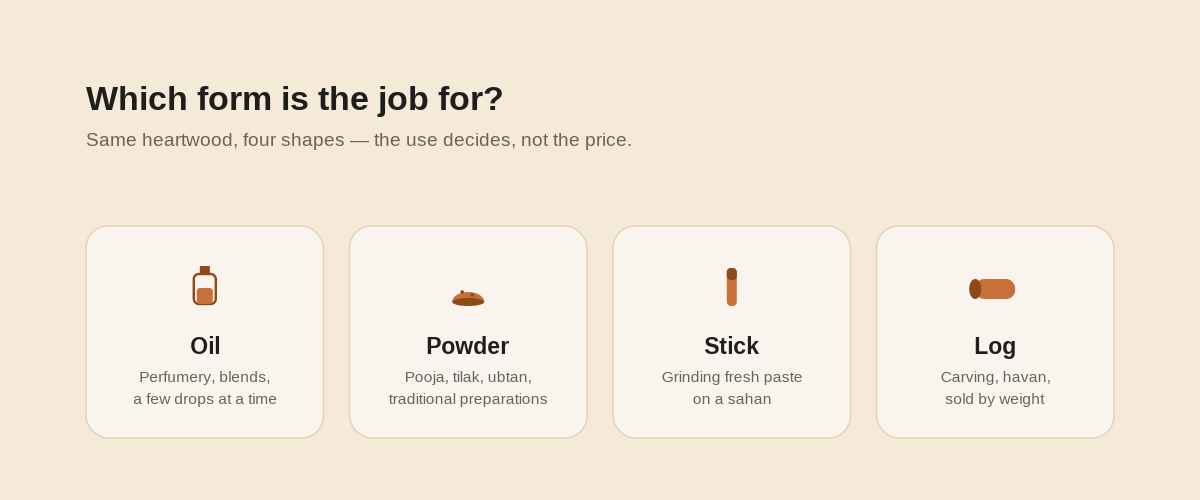
Quick selector
| Your purpose | Best product | Why |
|---|---|---|
| Daily tilak at home | Chandan Stick 20–30g | Ground fresh each morning; one stick lasts months |
| Daily tilak, minimal effort | Pure Chandan Powder 10g/25g | Mix with water in seconds |
| Abhishek / bathing the idol | Pure Chandan Powder 25g/50g | Larger paste quantity, flowing consistency |
| Havan / homa | Heartwood Log 500g/1000g | Solid wood for the fire; documented for temple records |
| Temple daily puja | Chandan Stick 40–50g | Durable for repeated grinding |
| Gifting | Stick 30–40g or Oil 3–5ml | Recognisable, lasting, easily presented |
| Perfumery / fragrance | Sandalwood Oil | The concentrated aromatic form |
| Traditional skincare packs | Pure Chandan Powder | Fine grind mixes cleanly |
The four products, honestly compared
Chandan Stick. The traditional form: you grind fresh paste on a sahan each day. Slowest to use, most satisfying, and — because you use only what you grind — the most economical per tilak. Choose 20–30g for a household, 40–50g for a temple.
Pure Chandan Powder. Heartwood ground to a fine powder at 4% oil content. Fastest to use; ideal for abhishek quantities and for anyone who will not grind daily. Buy sealed only — loose powder is where most adulteration lives.
Heartwood Log. Solid billets for havan, temple ritual and anyone making paste at scale. Also the raw form used by Ayurvedic, cosmetic and perfumery industries. The mark is stamped directly on the wood.
Sandalwood Oil. Steam-distilled from heartwood. A little goes a long way — the 3ml and 5ml bottles suit personal use; larger sizes are for perfumers and manufacturers.
Cost per use: the comparison that matters
Sticker price misleads in this category. A 20–30g stick at ₹749 grinding a household's daily tilak for several months costs a few rupees per day. A 10g powder bottle at ₹226 used for daily tilak lasts weeks. The log looks expensive at ₹8,500 per 500g, but per gram it is the cheapest heartwood we sell, which is why temples buy it. Work out price per gram and expected uses before deciding — our price-breakdown guide does the maths.
| Product | Entry size | Entry price | Approx. price per gram/ml |
|---|---|---|---|
| Pure Chandan Powder | 10g | ₹226 | ≈ ₹22.6 / g |
| Chandan Stick | 20–30g | ₹749 | ≈ ₹25–37 / g |
| Heartwood Log | 500g | ₹8,500 | ≈ ₹17 / g |
| Sandalwood Oil | 3ml | ₹1,199 | ≈ ₹400 / ml |
Prices as listed at time of writing; check product pages for current rates.
Common mismatches to avoid
- Buying oil for puja paste — oil is for fragrance, not for tilak or abhishek.
- Buying loose powder for 'value' — unsealed powder is the highest-risk purchase in this category.
- Buying a 500g log for a household — unless you make paste at scale, a stick serves better.
- Buying a 20g stick for a temple — it will wear out; choose 40–50g.
Frequently asked questions
Frequently asked questions
- Can I make powder from the stick myself?
- You can grate it, but the sahan method yields paste directly and wastes less. Buy powder if you want powder.
- Which size stick for a new household?
- 20–30g. Move up only if several people grind daily.
- Is the oil suitable for direct skin application?
- Sandalwood oil is highly concentrated. It is traditionally diluted in a carrier before any skin use; patch-test first. Traditional use — not medical advice.
- Do all four products carry the transit mark?
- Logs and sticks carry the physical mark; powder and oil carry sealed batch labels linked to marked source lots. See our verification guide.