
Where the oil comes from
Sandalwood's fragrance is not a surface coating; it is oil deposited inside the heartwood as the tree matures. The main aromatic molecules are alpha-santalol and beta-santalol, which together make up the large majority of genuine East Indian sandalwood oil — the international standard for the oil (ISO 3518) defines it largely by its santalol content. When heartwood is ground, the oil comes with it. Sapwood, sawdust and wood-flour fillers bring essentially none.
How oil content is measured
The laboratory approach is to extract the oil from a weighed sample of wood or powder — by steam distillation or solvent extraction — and weigh what is recovered, expressed as a percentage of the starting weight. Gas chromatography can further confirm that the oil recovered is genuine sandalwood oil (santalol-dominant) rather than an added fragrance. Our figure is derived from the heartwood lots that go into each powder batch, and the batch label on your bottle links to that lot.
Why 4% is the honest number
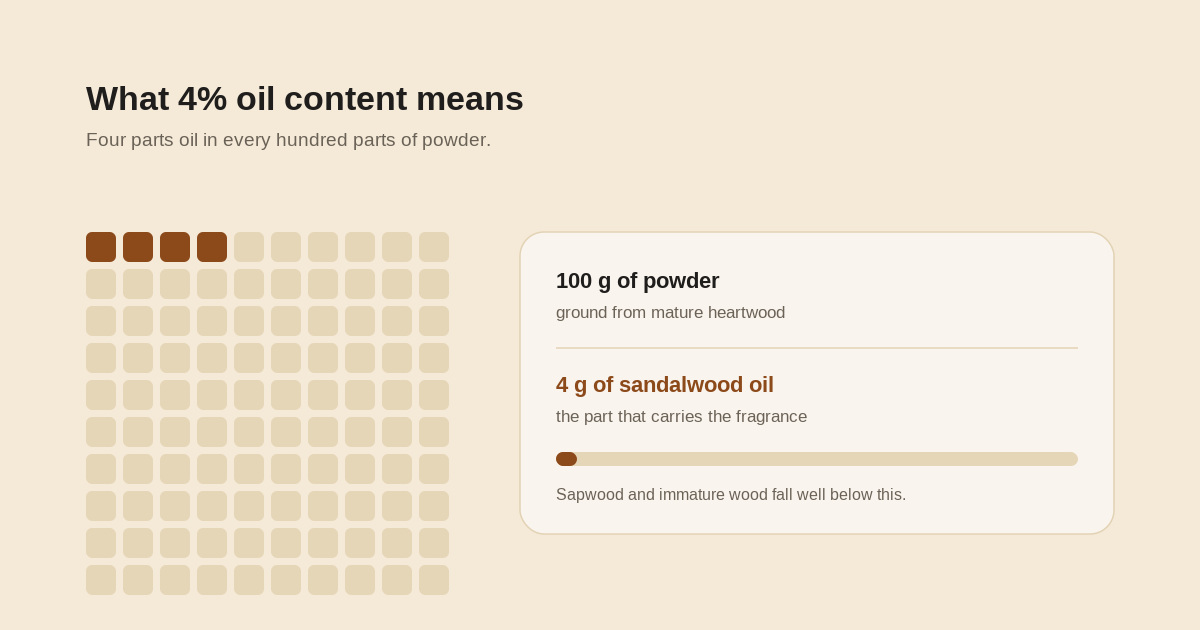
Heartwood oil content varies with tree age, region and the part of the trunk — mature Indian heartwood commonly yields in the low single-digit percentages by weight. A powder made from genuine, mature heartwood therefore lands in this range naturally. Claims far above it deserve scrutiny; a product that quotes no figure at all deserves more. What matters is not chasing the biggest number but knowing the number is real and traceable.
What oil content does for you in practice
- Fragrance that persists and deepens rather than fading in an hour.
- Paste that is smooth and slightly slippery between the fingers, not gritty.
- A distinct cooling sensation as traditional chandan paste dries on skin.
- Powder that keeps its character for years when stored airtight.
The question to ask any seller
'What is the oil content, and from which heartwood lot?' A genuine producer answers with a figure and a batch. A reseller of unknown powder usually cannot. This one question does more to protect you than any home test.
Frequently asked questions
Frequently asked questions
- Is higher oil content always better?
- Within the genuine range, higher generally means more fragrant paste. Suspiciously high claims, or strong fragrance with no stated figure, usually mean added synthetic fragrance.
- Can oil content be faked with sprayed fragrance?
- The smell can be faked briefly; the measured oil content and its chemical profile cannot. That is why we state the number.
- Does oil content drop over time?
- Slowly, and mainly with poor storage. Airtight, away from heat and sunlight, powder holds its oil for years.
- Is 4% the same as the oil sold in bottles?
- Related but different: bottled sandalwood oil is the distilled, concentrated oil itself. The 4% is how much of that oil is present inside the powder.