
The comparison at a glance
| Name | What it is | Fragrance | Typical use |
|---|---|---|---|
| Indian sandalwood (Santalum album) | True sandalwood; native to India; the species of chandan tradition | Soft, sweet, woody, long-lasting; santalol-rich oil | Puja, tilak, Ayurvedic tradition, fine perfumery |
| Australian sandalwood (Santalum spicatum) | Related Santalum species grown in Western Australia | Drier, sharper, less sweet; lower santalol | Commercial perfumery, incense |
| Pacific sandalwoods (S. austrocaledonicum, S. yasi etc.) | Other Santalum species from the Pacific islands | Closer to album than spicatum but variable | Perfumery |
| Red sanders / 'lal chandan' (Pterocarpus santalinus) | Different tree entirely (legume family); red-coloured wood | Almost no fragrance | Dye, colour, woodwork; separate ritual traditions |
| 'Sandal' fragrance products | Synthetic aroma chemicals or blends | Loud, fades fast, no depth | Cheap incense, soaps, 'sandal' oils |
Indian sandalwood: what makes it the reference
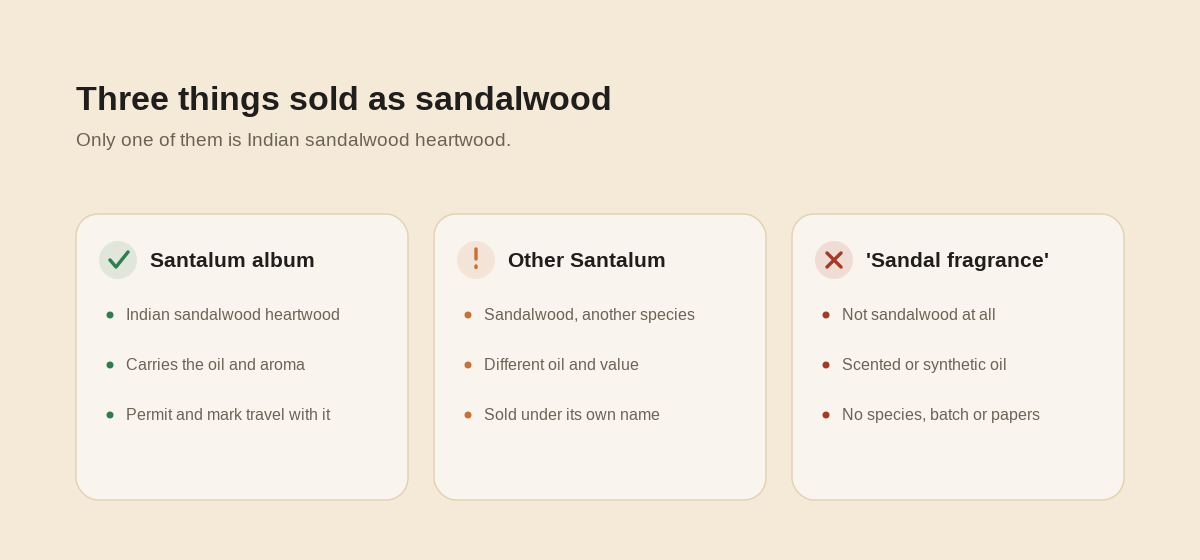
Santalum album is the species around which India's chandan tradition — tilak, abhishek, temple use, classical Ayurvedic texts — was built. Its heartwood oil is dominated by alpha- and beta-santalol, which give the characteristic soft, sweet, persistent aroma that other species approximate but do not match. It is also the species that is regulated as forest produce in Indian states, which is why documentation matters when you buy it.
Red sanders: the naming trap
'Lal chandan' or red sandalwood is a different tree altogether. Its wood is deep red, prized for colour and carving, and almost scentless. It has its own traditions and its own regulations, but it is not a substitute for white sandalwood in tilak, paste or fragrance. Powder sold as 'chandan' that is reddish and unscented is red sanders — or coloured filler.
Synthetic 'sandal' fragrance
Most sandalwood-scented consumer products contain no sandalwood. They use aroma chemicals designed to evoke it — effective in a soap, meaningless in a puja. The tell is the fragrance behaviour: synthetic sandal is strong immediately and gone within the hour; genuine heartwood is gentle at first and persists for days. An 'oil' that is cheap and intensely scented is fragrance oil, not sandalwood oil.
Reading a label
- Look for the botanical name: Santalum album. 'Sandal', 'chandan', 'sandalwood fragrance' without a species name tells you nothing.
- Look for origin and documentation: source lot, batch, transit mark reference.
- Look for the oil content on powder and the distillation method on oil.
- Be wary of 'sandalwood oil' priced like a fragrance oil — genuine oil is one of the costliest natural oils in the world.
Frequently asked questions
Frequently asked questions
- Is Australian sandalwood 'fake'?
- No — it is a genuine Santalum species and a legitimate perfumery material. It is simply a different, drier-smelling wood with a different oil profile. It is not chandan in the ritual sense.
- Can red sandalwood be used for tilak?
- Some traditions use red sanders paste for colour, but it is not a fragrant substitute for white chandan. Know which one you are buying.
- Does your oil contain any other species?
- No. Our oil is distilled from Santalum album heartwood only, with batch records for each lot.
- Why do 'sandalwood' incense sticks smell so different from your wood?
- Because most contain synthetic fragrance, not sandalwood. The difference you notice is the difference between an imitation and the material itself.